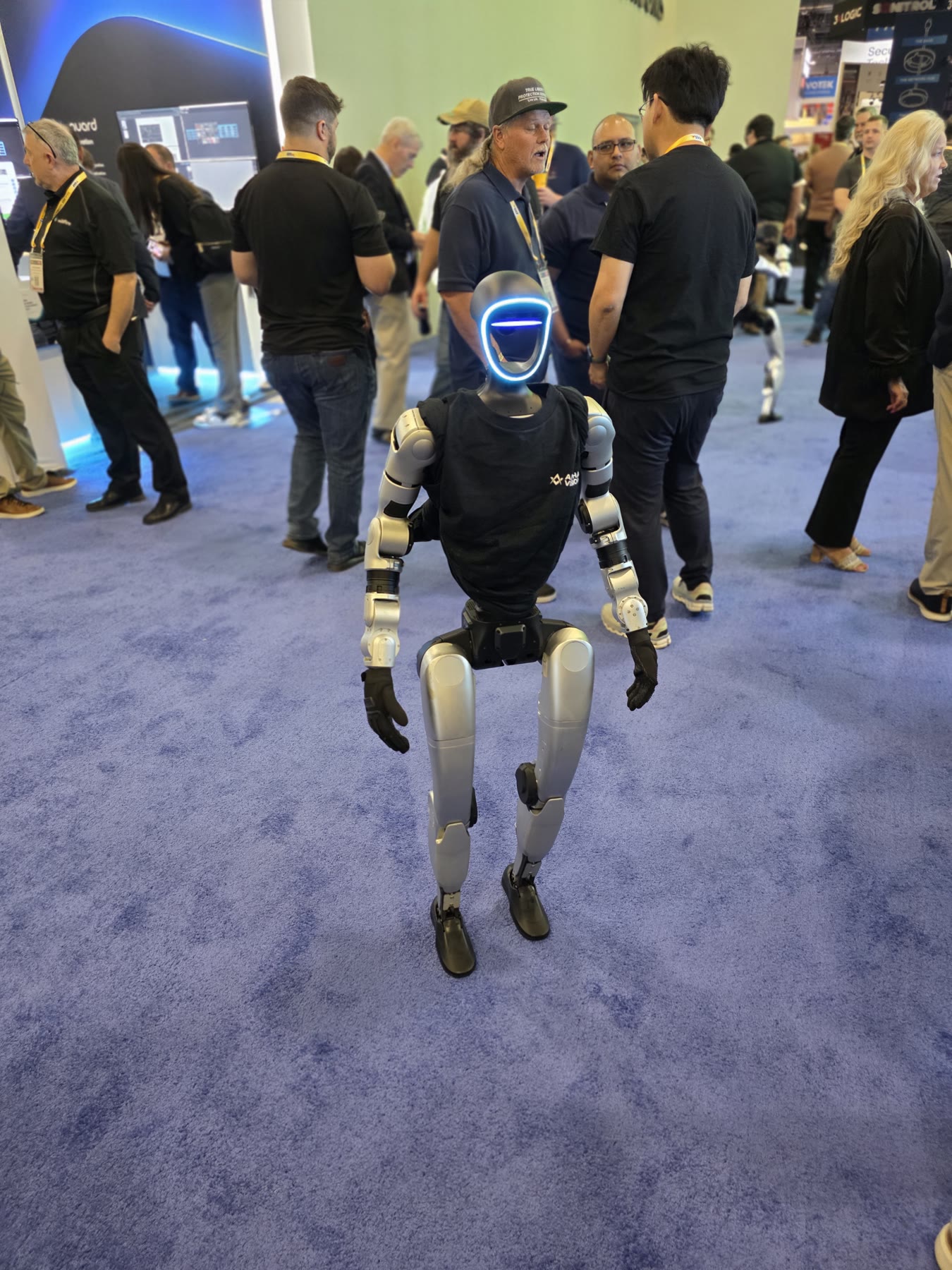
LAS VEGAS, Nevada — Privateer Security Forces attended ISC West 2026 to examine the technologies being presented as the next generation of physical security. Across the exhibit floor, autonomous drones, quadruped robots, humanoid machines, edge artificial intelligence, and connected sensing systems competed for the industry’s attention.
The event brought more than 29,000 security professionals and over 750 exhibiting brands to The Venetian Expo, according to ISC West. For Privateer, the value was not simply seeing what could move, fly, detect, or analyze. It was the opportunity to judge those systems from the perspective of people who must make security work after the demonstration ends.
That distinction produced a more demanding conclusion. Robotics may extend observation and reduce human exposure to some repetitive or hazardous tasks. But an autonomous machine operating in public is also a visible, valuable, networked asset. It can be obstructed, vandalized, stolen from, deliberately damaged, or attacked with a firearm. If the system cannot survive that environment—or requires an officer to protect it—its business case changes quickly.
A security robot is also something that must be secured
A trade-show demonstration proves that a platform can perform under controlled conditions. A field deployment must also account for bad weather, difficult terrain, communication loss, curious bystanders, deliberate interference, criminal intent, repair time, and the consequences of losing the machine itself.
The hardware is becoming capable. The environment remains hostile.
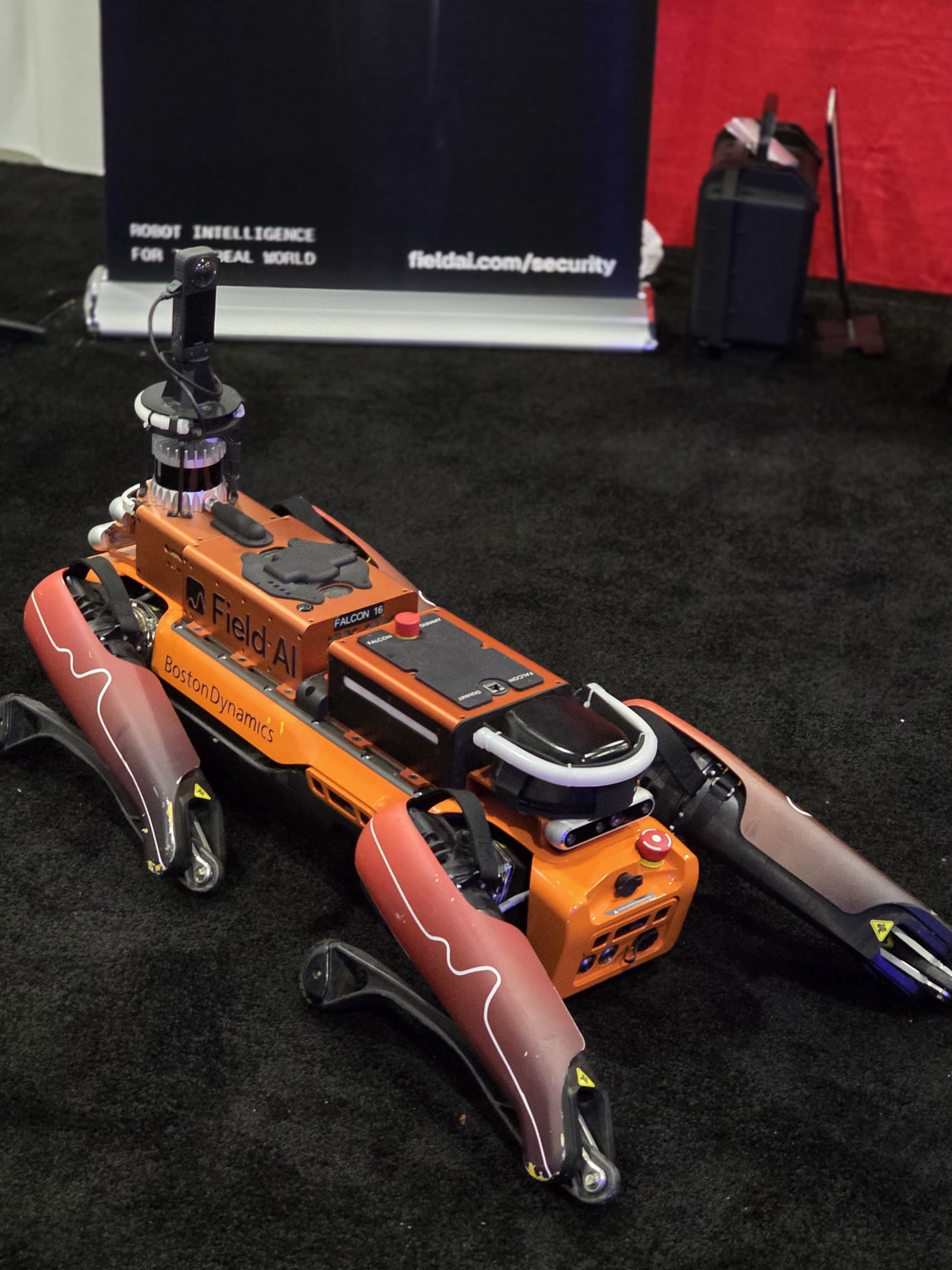
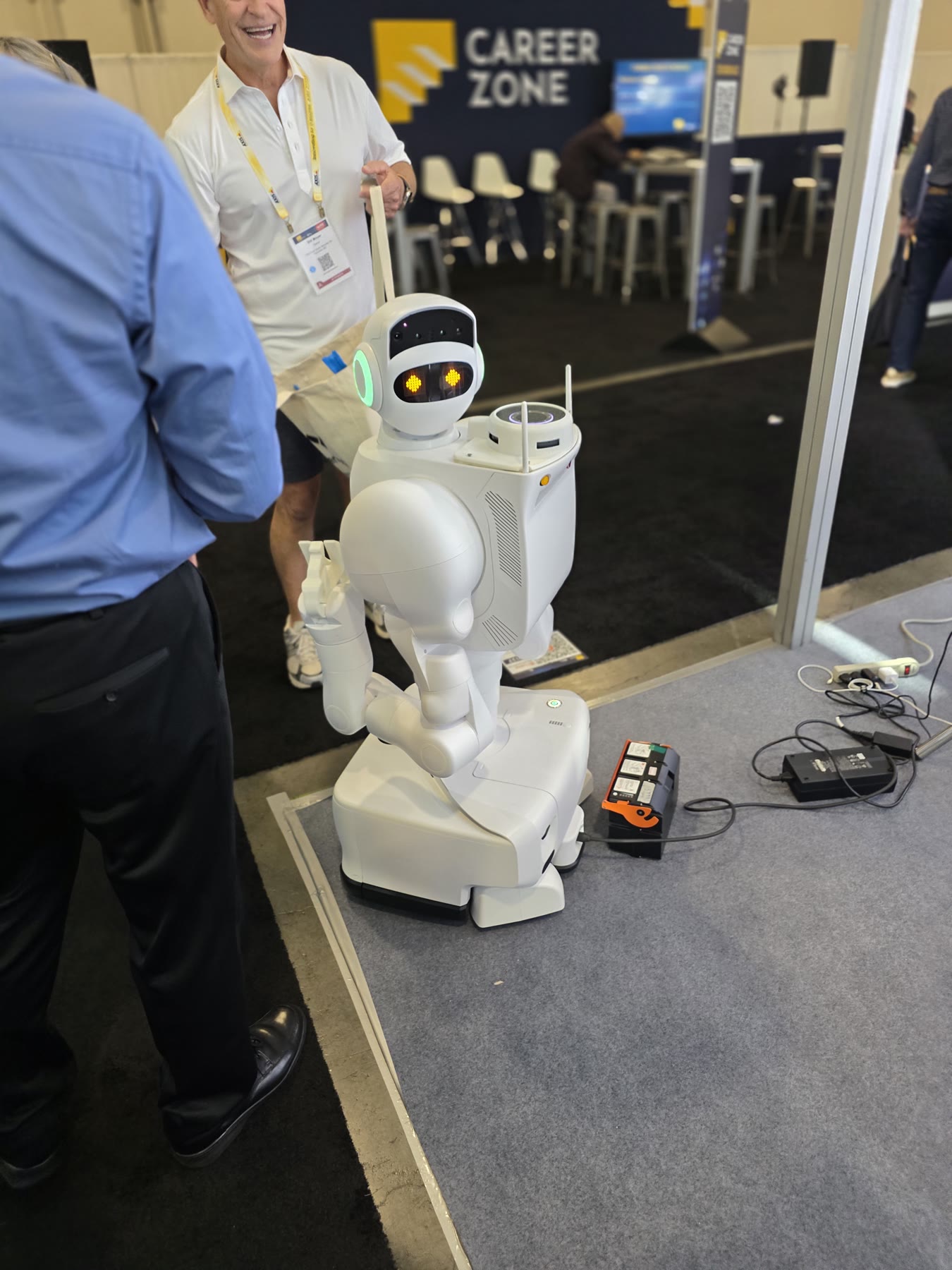
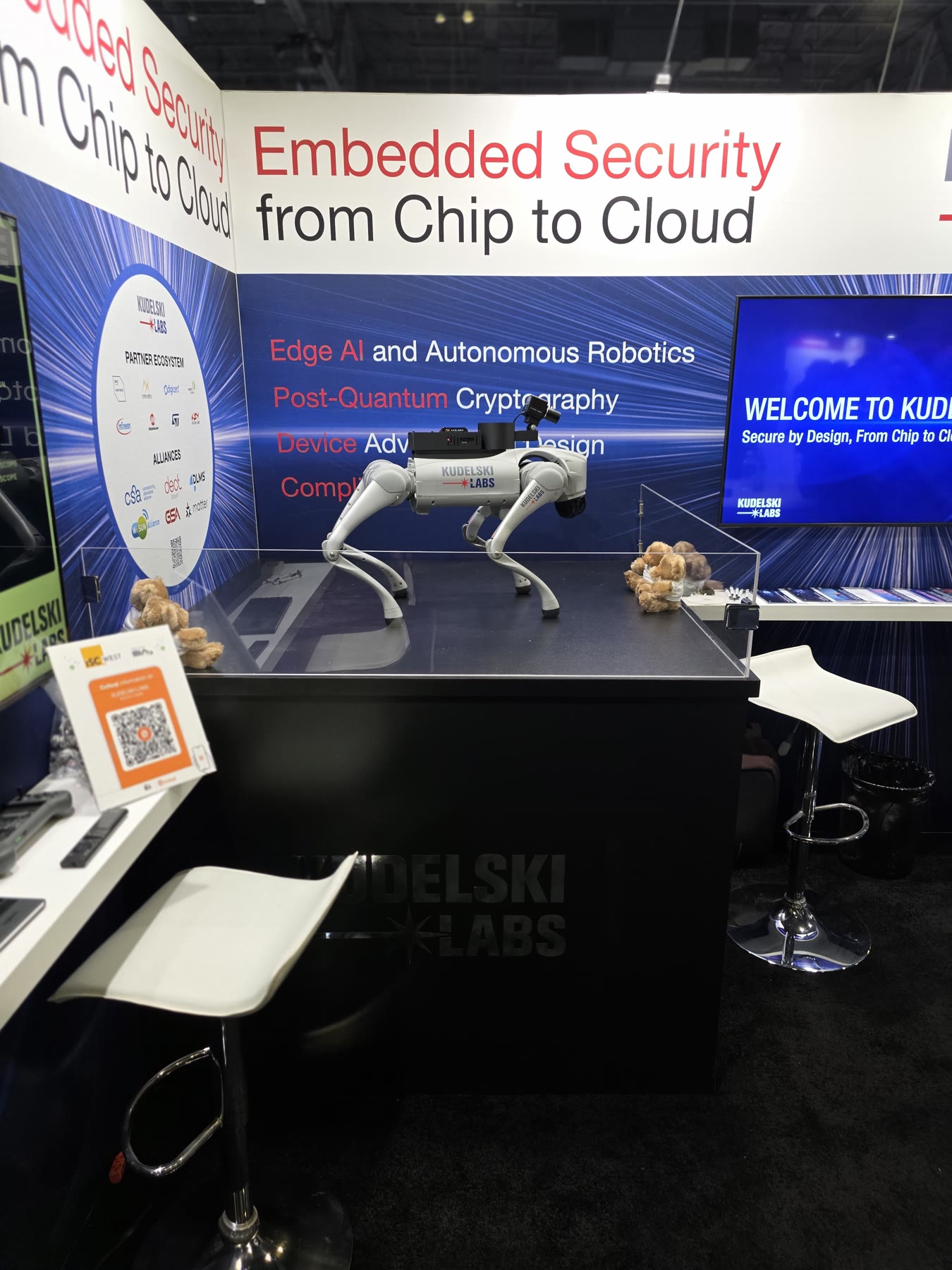
ISC West made clear that security robotics is no longer confined to a laboratory video. Humanoid systems moved among attendees. Quadruped platforms carried cameras and other sensors. Compact service robots demonstrated interaction in crowded indoor spaces. The hardware was increasingly mobile and the software increasingly ambitious.
Privateer’s interest is practical. A mobile sensor could inspect a remote corner, repeat a route, approach an alarm, or enter a location where sending a person first would be unnecessarily risky. Those are meaningful possibilities. They do not erase the fact that public-facing security work includes people who do not cooperate with the plan.
A robot does not need to be universally disliked to face a serious vulnerability. One hostile person can disable an expensive platform before it identifies the threat, and the cost is larger than the damaged hardware. The operator may lose cameras, recorded data, communications equipment, and coverage at the moment those resources are most needed.
Informal show-floor conversations also exposed the scale of the capital at risk. Privateer heard approximate acquisition figures ranging from about $5,000 for small, basic quadrupeds with limited security utility, to roughly $60,000 for a compact rolling platform, and as much as $200,000 for advanced quadrupeds once additional autonomy software was included. Those figures were not formal quotations and should not be read as fixed vendor pricing. They do, however, illustrate why survivability, repair time, insurance, and replacement cost belong in the security assessment.
The public will not treat every machine like a protected employee
American deployments must be planned around the environment that exists, not the one a product demonstration assumes. Valuable equipment placed within public reach can be vandalized or stripped for parts. Cameras are obstructed. Boundaries are tested. Firearms add the possibility that a person can destroy a costly machine from a distance. Novelty and resentment toward AI may make an autonomous platform more conspicuous, not less.
Public unease about artificial intelligence adds another variable. A 2025 Pew Research Center survey found that 50% of U.S. adults were more concerned than excited about the growing use of AI in daily life, while 10% were more excited than concerned. That finding does not predict violence against a robot, but it does warn operators not to assume automatic public trust or goodwill.
Privateer’s position is straightforward: the risk of deliberate damage belongs in the deployment model. A platform intended for an open parking lot, construction site, transit property, or public venue should be evaluated for tamper detection, standoff distance, safe withdrawal, data protection, recovery after damage, replacement lead time, and the human response required when the machine itself becomes the incident.
A robot that creates more protection burden than it removes is not a force multiplier.
Drones can move the camera. They do not eliminate the decision.
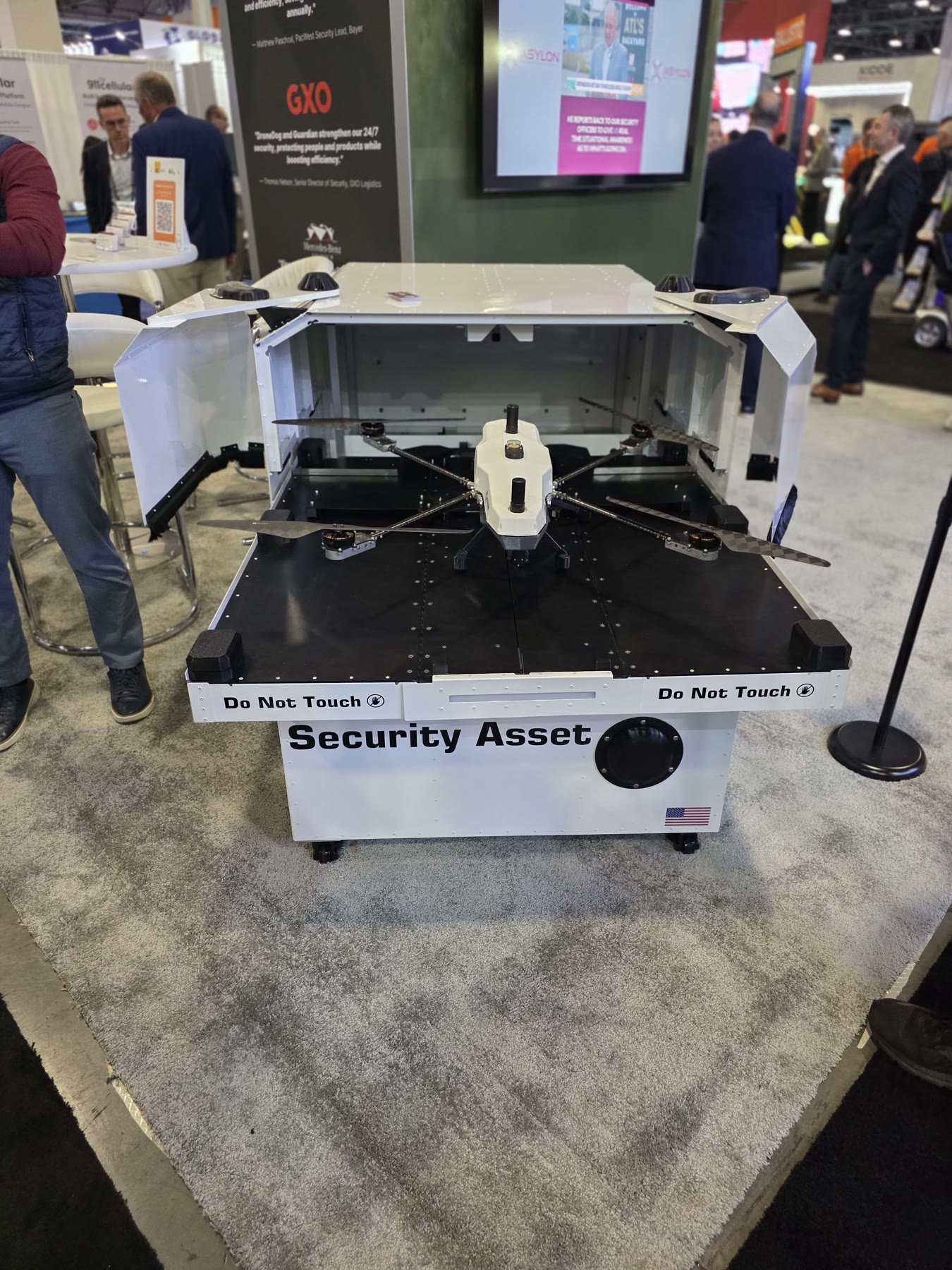
Automated drone systems offered one of the clearest operational ideas at the show: keep an aircraft ready in a protected station, launch it for a scheduled patrol or alarm, and return it for charging or a battery exchange. On a large property, that can put a camera over a distant area faster than a ground patrol can drive there.
The useful question is what happens next. Who verifies what the aircraft sees? What happens in poor weather or restricted airspace? How is the video retained? Can the station be disabled from the ground? What does the system do when its connection fails? And when an alarm requires contact, detention, medical aid, or a lawful use-of-force decision, who responds?
Those are not arguments against aerial systems. They are the difference between buying a machine and building an operation. Asylon, whose technology was represented in the exhibit shown below, describes deployments that pair automated aerial and ground platforms with continuous human oversight. That human layer is not incidental; it is part of the security system.
Every mobile sensor expands the digital perimeter
A security robot is also a computer carrying cameras, radios, credentials, software, and data through the physical world. That makes cybersecurity inseparable from physical protection. The exhibit floor’s emphasis on edge AI, embedded security, and chip-to-cloud protection reflected the same convergence ISC West placed at the center of its 2026 program.
For an operator, basic questions follow. What information remains on the device if it is captured? Can a lost platform expose network credentials or site maps? Are software updates signed and controlled? Can an attacker spoof its sensors, interrupt its command link, or use the machine as a path into another system? Does it fail safely when it cannot verify its instructions?
These questions matter before a robot crosses a perimeter. A machine purchased to reduce one kind of blind spot should not quietly create another.
Better industry access—and a clearer view of Full Sail
Robotics produced the most unusual photographs, but it was not the only reason the trip mattered. Privateer developed useful new relationships with people working in camera systems, metal detection, weapon-detection technology, and other parts of the modern security stack. Those conversations improved the company’s understanding of what is available now, what is approaching practical deployment, and where integration still falls short.
Privateer also attended ISC West as a software builder. Full Sail—the operations platform Privateer developed around its own field work—was not exhibited. The product and company are not yet ready to support a trade-show booth at that scale, and Privateer has no interest in pretending otherwise.
The comparison was nevertheless instructive. During its time on the floor, Privateer did not encounter a single exhibit that matched Full Sail’s combination of patrol and incident records, live operational coordination, client and tenant workspaces, property context, evidence, payroll, invoicing, and automations in one shared system. That observation is not a claim that Full Sail is finished or that no competing capability exists anywhere. It is evidence that the operational problem Privateer has spent years solving remains distinct from most products being marketed on the show floor.
ISC West therefore served two purposes: it connected Privateer with technologies the company may use, and it clarified the value of technology Privateer is already building. The next step for Full Sail is continued field proof, product discipline, and readiness—not a premature booth.
Privateer will judge autonomous systems by field outcomes
Privateer left ISC West interested in the direction of the technology and unconvinced that novelty alone establishes value. Any serious evaluation must compare the complete system against a trained officer, a fixed camera network, a mobile patrol, or a combined approach.
Detection quality
Does the platform find meaningful activity, verify it, and deliver usable information—or simply create more alarms?
Physical resilience
Can it withstand weather, terrain, tampering, impact, and deliberate attack without becoming an easy capital loss?
Human command
Who verifies the alert, controls escalation, protects rights, and assumes responsibility when judgment is required?
Total operating cost
Purchase price is only the beginning. Staffing, connectivity, insurance, maintenance, repair, downtime, and replacement all count.
The likely future is not a contest between people and machines. It is a layered operation in which technology extends the observation, documentation, and reach of trained professionals. Privateer remains open to that future while continuing to ask the question that matters after every polished demonstration: will it still work when someone actively wants it not to?
Event record and technology context
Privateer’s attendance, photographs, and operational assessment come from the company’s March 25 visit to ISC West. The sources below document the event and provide context for technologies discussed in this article.
- ISC West: 2026 event highlights and attendance figures
- ISC West: 2026 dates, venue, and converged-security program
- FieldAI: autonomous robotics in dynamic, unstructured environments
- Asylon: case study combining automated drones, ground robotics, and human oversight
- Pew Research Center: Americans’ concern and excitement about AI