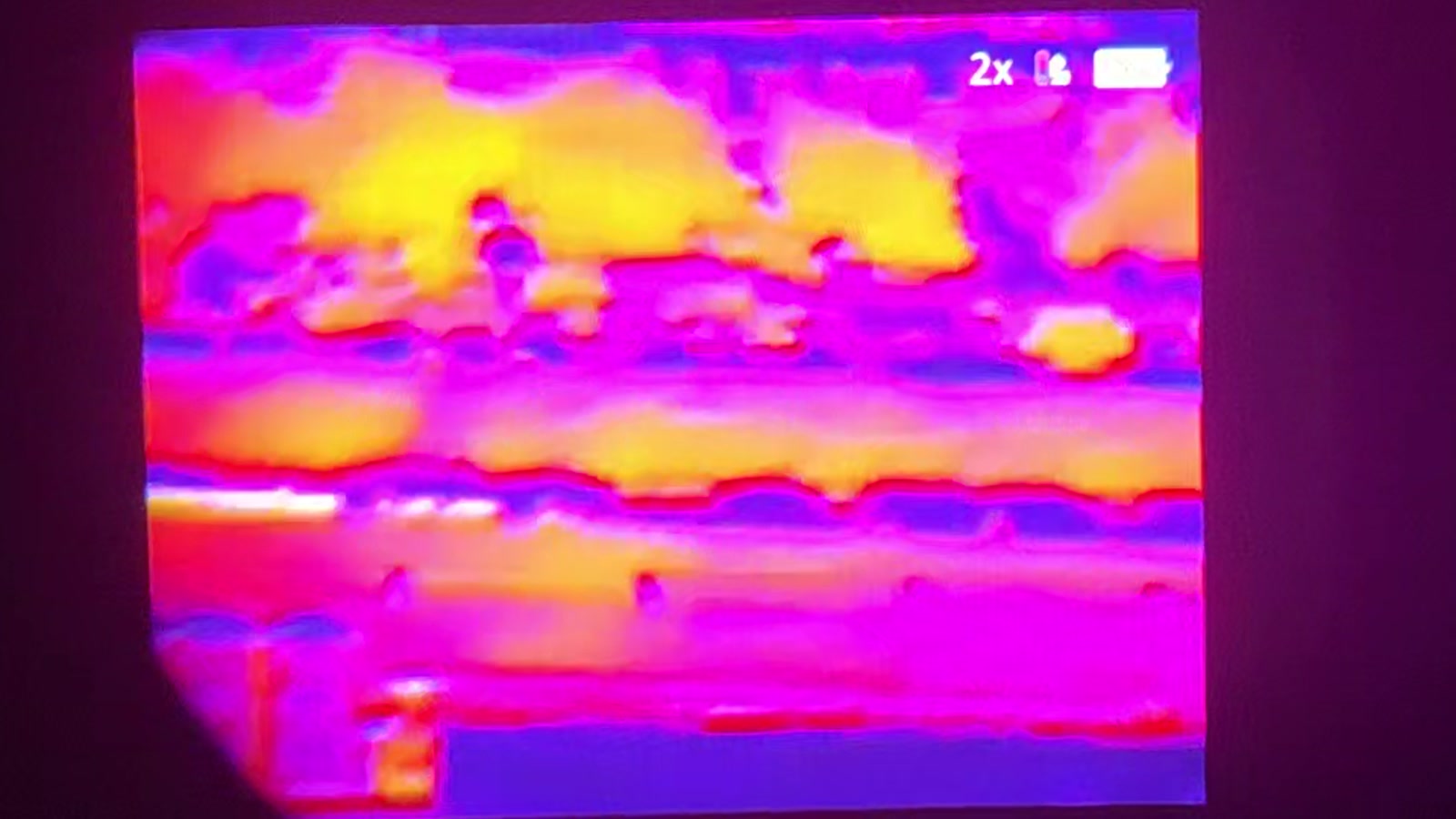
TUCSON, Ariz. — From an elevated position at Mosaic Quarter, a Privateer observer can scan broad sections of the property without turning night into day with floodlights. A handheld thermal imager reveals temperature differences across the dark site; a mobile officer remains ready to investigate what the screen cannot explain.
The operating model is simple but disciplined. The observer follows movement and developing heat patterns from above, communicates what matters, and directs the ground-response officer toward the right area. The interceptor then establishes ordinary visual context, determines who or what is present, and takes the next lawful step.
Thermal imaging does not replace a security professional. It gives one an additional sense. The device can make a warm figure, running engine, recently disturbed surface, or cooling structure stand apart from its surroundings—but the meaning of that contrast still belongs to a trained human being.
Detect from above. Interpret in context. Verify on the ground.
Thermal imaging can reveal that a warm object is moving through a scene. It does not, by itself, establish identity, intent, authority, or the correct response. A trained observer interprets the live image and a second professional confirms what is happening at ground level.
How a handheld thermal imager sees the desert at night
Ordinary eyes and cameras build an image from visible light reflected by a scene. Thermal imagers work differently. Objects emit infrared energy according to their surface temperature. A thermal sensor detects small differences in that energy and converts them into an image the operator can read.
Scout-class handheld systems use an uncooled microbolometer to sense long-wave infrared energy. Instead of showing natural colors, the display maps relative heat into palettes such as white-hot, black-hot, or colorized heat. A person, animal, running engine, recently handled object, sun-warmed wall, and cooling patch of soil can each appear differently because each is releasing heat at a different rate.
No visible light required
Thermal imaging does not need moonlight, floodlights, or reflected infrared illumination to form an image. Complete darkness is not complete blindness.
Contrast comes from heat
The key is the temperature difference between a possible subject and the surrounding background, not the color of clothing or the brightness of the scene.
Detection before identification
At long range, the device helps answer “is something warm moving there?” Identity and intent still require closer observation and ground verification.
Operator judgment matters
A trained person tracks movement, compares the thermal image with site knowledge, and decides whether the ground officer needs to investigate.
Privateer uses handheld thermal devices in the same general class as the FLIR Scout family. As a current manufacturer reference point, FLIR lists the Scout Pro with a 640 × 480 VOx detector, a 32-degree field of view, multiple display palettes, and human heat-signature detection up to 500 meters. Exact usable distance varies by model, lens, target size, weather, terrain, background temperature, and the level of detail needed. Those published specifications are context—not a blanket promise for every device or every scene. Review FLIR’s Scout Pro specifications.
Why thermal overwatch is especially valuable after dark
Southern Arizona presents a demanding visual environment. Large open distances can help observation, but unfinished structures, equipment, fencing, dust, deep shadows, and changing grades can make ordinary nighttime scanning difficult. Thermal imaging removes the need to illuminate every sector just to look for movement.
After sunset, desert soil, concrete, steel, vehicles, and vegetation release heat at different rates. A person moving through that changing background will often maintain enough thermal contrast to stand out to a careful operator. Clothing that blends into the visible scene does not automatically erase the wearer’s surface heat pattern.
The technology is most impressive on nights when the visible scene offers almost nothing: no moon, little ambient light, long shadows, or glare around isolated work lights. Thermal imaging keeps producing a heat-based picture while the human observer continues scanning normally.
The desert is not thermally simple
Hot environments can also create clutter. Sun-loaded masonry, parked equipment, roofing, engines, and exposed metal may remain warm for hours. During periods when the background temperature approaches the apparent temperature of a person, contrast can fall. Experienced operators account for those low-contrast periods by changing palettes, adjusting their scan, comparing movement over time, and using visible-light confirmation.
Dust, light haze, and some visual obscurants may affect thermal imaging less than ordinary cameras, but no handheld device has unlimited range. Humidity, heavy precipitation, dense obstructions, lens selection, sensor resolution, and atmospheric conditions all influence what the operator can reliably detect.
What thermal imaging does—and what it does not do
Privateer treats thermal observation as one layer in a larger security system. Its value comes from combining superior nighttime detection with communications, site knowledge, ground mobility, body-camera documentation, and professional judgment.
- It detects heat contrast; it does not automatically identify a person or determine criminal intent.
- It works in complete darkness; it does not see through solid walls, buildings, heavy terrain, or most glass.
- It can extend human observation; it does not eliminate blind spots, atmospheric effects, or the need for confirmation.
- It can cue a response; the ground officer still assesses the facts and acts within post orders, contract authority, and law.
For active-site security, Privateer does not publish exact observation posts, scan sectors, operating schedules, communications procedures, coverage limits, or ground-response routes.
A layered protective model for Mosaic Quarter
Mosaic Quarter is a major Southern Arizona development with the broad footprint, changing terrain, active work areas, equipment, and after-hours visibility challenges common to complex construction environments. Its official project materials describe a privately funded Tucson destination built around sports, entertainment, community, accessibility, and collaboration.
Privateer’s current deployment adds real-time elevated thermal observation to the ground-level security presence. The observer is not simply watching a bank of automated alerts. A human being is continuously reading the property, following meaningful movement, and maintaining communication with another human being who can respond.
That combination is the point: technology extends the observer’s reach; elevation expands perspective; radio communication collapses distance; and the interceptor provides direct verification. Each layer covers a limitation of the others.
The accompanying July 4 field footage shows the observer moving between colorized and white-hot palettes as the view changes. Each palette emphasizes contrast differently. Neither identifies a person, determines intent, or removes the need for confirmation on the ground.
Further reading
The technical explanations in this article were checked against current manufacturer materials. Product capabilities vary by model and conditions.